
Course

EMDR Therapy with Complex Trauma and Dissociative Personality Structure

Format

Recorded Asynchronous Course

Duration

12.5 hours

Presenter

Jim Knipe, PhD

Prices

$350

General Price

$175

HAP Faculty Volunteers
HAP Faculty Volunteers click here to apply your faculty discount

About

Course Description

The term Complex PTSD (Herman, 1992, van der Kolk, 2005) has been proposed to describe a pattern of negative effects of prolonged and extreme stress, particularly during childhood. The focus of this workshop is to describe a theoretical framework, and specific therapy “tools” which may be useful in providing effective therapy, within the EMDR Adaptive Information Processing Model, to individuals suffering with Complex PTSD. Important concepts and particular interventions will be illustrated through video examples and transcripts from therapy sessions. Dr. Knipe presents user-friendly methods for identifying and treating specific psychological defenses and dissociative symptoms with accompanying evidence from available research or case studies.

Intended Audience

Psychologists, Counselors, Mental Health Clinicians, etc. This course is designed for licensed mental health clinicians who have completed an approved EMDR Basic Training.

EMDRIA and CE's credits

12.5 CE Credits (CEs included in course price) and 12 EMDRIA Credits (Included in course price). Please see navigate to the FAQ section with the dropdown titled "How to obtain your credits/certificates" for more details about CEs.

Skill Level of Audience

Beginner, Intermediate and Advanced.

Course Outline

Day 1
Day 2
An Adaptive Information Processing model of treating psychological defenses occurring within the context of Complex PTSD
  • Overview of an Adaptive Information Processing model of Complex PTSD and dissociation.
  • Video example of targeting avoidance defense. The “Loving Eyes” alternative to EMDR Phase 3.
  • Video example of targeting avoidance in a client with a dissociative personality structure.
  • Targeting idealization defenses. Targeting addictions. Video example of targeting a smoking addiction.
  • An Adaptive Information Processing model of treating dissociative symptoms and dissociative personality structure. The origins of dissociation in disrupted attachment.
Targeting and safely resolving internally-phobic separation between dissociative personality parts
  • Video example of a method of reorienting a client who is experiencing dissociative abreaction.
  • The Back-of-the-Head Scale/Constant Installation of Present Orientation and Safety (BHS/CIPOS) method.
  • Two videos demonstrating variations of the BHS/CIPOS method: 1) a client with fear of dissociated physical sensations, and 2) a combat veteran with a dissociative disorder, with a 15-year follow-up after the initial EMDR sessions.
  • The use of CIPOS with defense. EMDR-related treatment of “The problem of attachment to the perpetrator.” Video example of targeting the defense of shame/idealization of the perpetrator, in the treatment of a highly dissociative client.
  • Additional variations on how EMDR- related procedures may be used to help dissociative clients who present with chronic shame-based depression and problematic attachment to the perpetrator. Two video examples.

Learning Objectives

Participants will be able to identify three conceptually different types of damage to personality development that can occur as a result of difficult childhood experiences
Participants will be able to describe several different ways of targeting and resolving avoidance defenses, idealization defenses and shame defenses, and how these targeting methods may be modified for clients with dissociative personality structure
Participants will be able to describe the "Loving Eyes" method, an alternative to the EMDR Assessment Phase (EMDR Phase 3)
Participants will be able to describe the Back-of-the-Head Scale (BHS), and the wide variety of applications of the Constant Installation of Present Orientation and Safety (CIPOS) method
Participants will be able to describe the connections between shame-based depression and "the problem of attachment to the perpetrator," and participants will know several specific approaches to AIP targeting of dysfunctional attachments
Participants will be able to identify the experiential distortions ( I.e. Unresolved traumatic “reliving’s,” unresolved psychological defenses) that are preventing personality integration in an individual with a dissociative disorder
Participants will be able to identify the steps in setting up and then implementing the Internal Healing Dialogue (IHD) procedure, which can be very useful in assisting a dissociative person with personality integration.
Participants will be able to identify important considerations and procedures that can be useful in the EMDR-related treatment of a person with narcissistic defenses
Meet the instructor

Jim Knipe, PhD

Jim has been a licensed psychologist in private practice in Colorado since 1976 and has been using EMDR since 1992. He is a Trauma Recovery/HAP Trainer, an EMDRIA Approved Consultant and Instructor, and was designated a "Master Clinician" by EMDRIA in 2007. He was a Keynote speaker at the 2010 EMDRIA conference, 2015 EMDR Canada conference and was an invited guest speaker at the 2006, 2007, 2010 and 2014 EMDRIA Annual Conferences, the 2006, 2008 and 2012 EMDR-Europe Annual Conferences, the 2010 EMDR Asia Conference, and national EMDR conferences in Denmark, Germany, Scotland, Italy, Belgium, Sweden, Spain, The Netherlands, Turkey, Brazil and Japan.

He has been involved with Trauma Recovery/EMDR Humanitarian Assistance Programs, serving as Coordinator for training programs in Turkey and Palestine, and serving on the Board of Directors and as Research and Training Director. He has also been involved in Trauma Recovery/HAP programs in Oklahoma City, New York (following 9/11), Sri Lanka and Indonesia.

In addition, he is a co-author of published outcome research documenting the effects of EMDR with survivors of 9/11 and with those traumatized by the 1999 Marmara earthquake in Turkey.

Dr. Knipe has contributed chapters to EMDR Casebook (Manfield, 2002), EMDR Solutions, Volumes I and II (R. Shapiro, 2005, 2009), Healing the Heart of Trauma and Dissociation (2007), EMDR Scripted Protocols: Special Populations (Luber, 2009), and EMDR and Dissociation: The Progressive Approach (Gonzalez and Mosquera, 2012).

His book, EMDR Toolbox: Theory and Treatment for Complex PTSD and Dissociation, was published in August 2014, and he is a co-author (with Dolores Mosquera) of an article in the Winter 2015 issue of the Journal of EMDR Practice and Research, entitled Understanding and Treating Narcissism With EMDR Therapy.

Jim Knipe, PhD

Frequently Asked Questions

Cancelations

There are no cancelations/refunds for any distance learning courses.

Grievances

Grievances can be sent in writing by email to registration@emdrhap.org and will be handled within 10 business days.

Trauma Recovery, EMDR Humanitarian Assistance Programs (Trauma Recovery/HAP) 
is fully committed to conducting all activities in strict conformance with all our public facing and internal and accreditation grievance policies. Trauma Recovery/HAP will comply with all legal and ethical responsibilities to be non-discriminatory in promotional activities, program content, and in the treatment of program participants. 

The monitoring and assessment of compliance with these standards will be the responsibility of the Education Chair/Continuing Education Director in consultation with the member of the continuing education committee (Trauma Recovery/HAP Training Operations Team), the Trauma Recovery/HAP's Ethics Chairperson and the Convention/Conference Chairperson.

While Trauma Recovery/HAP goes to great lengths to assure fair treatment for all participant and attempts to anticipate problems, there will be occasional issues which come to the attention of the convention staff or an officer of Trauma Recovery/HAP. This procedural description serves as a guideline for handling such grievances.

When a participant, either orally or in written format, files a grievance or expects action on the complaint, the following actions will be taken. If the grievance concerns a speaker, the content presented by the speaker, or the style of presentation, the individual filing the grievance will be asked to express their comments in written format. The Educational Chair/Continuing Education Director will then pass on the comment to the speaker, assuring the confidentiality of the aggrieved individual.
If the grievance concerns a workshop offering, its content, level of presentation, or the facilities in which the workshop was offered, the Convention/Conference Chairperson will mediate and will be the final arbitrator. If the participant requests action, the Convention/Conference Chairperson will:
2a) attempt to move the participant to another workshop.
2b) provide a credit for a future workshop or on-demand course equally valued;
2c) or provide a partial or full refund of the workshop fee.
**Actions 2b and 2c require written notes documenting the grievance for record keeping purposes. Either note need not be signed by the aggrieved individual.

If the grievance concerns Trauma Recovery/HAP CE program in a specific regard, the CE Educational Chair/Continuing Education Director will attempt to arbitrate and will engage the Clinical Consultant team and when necessary, the executive Director. When the grievance is filed by a social worker, the Social Worker Consultant will be involved in the investigation and resolution of all grievance. If further escalation is necessary, the grievance will be sent directly to the Board President.

Contact: Anna Riedel, CE Director
Email: registration@emdrhap.org
Telephone number: (203) 288 4450
Address: 80 Garden Center, Suite 200, Broomfield, CO 80020

Trademark Restrictions Purchasing / Showing content to others

** Please note** this distance learning course was given ownership from the presenter, Jim Knipe, to Trauma Recovery/HAP and it cannot be used for resale and only should be viewed by the purchaser.

** HIPAA Regulations: Please note that this course may contain protected health information (PHI). Any unauthorized use or disclosure of this PHI is strictly prohibited, this includes recording and/or reproducing any part of this training video. This video presentation contains videos of clients and case discussions. The presenter has received permission to use the videos to assist in the education and training of clinical professionals who must comply with confidentiality standards.

ADA assistance

Facilities used by Trauma Recovery/HAP for in-person training events are ADA compliant. Should you need any special accommodations (ADA) for an in-person training event, please contact Trauma Recovery/HAP staff at info@emdrhap.org at least 10 business days prior to the start of the training event. On-demand courses with videos offer closed captioning. If you encounter any inaccuracies or synchronization issues with the closed captioning, please contact associate@emdrhap.org.

How to obtain your credits/certificates
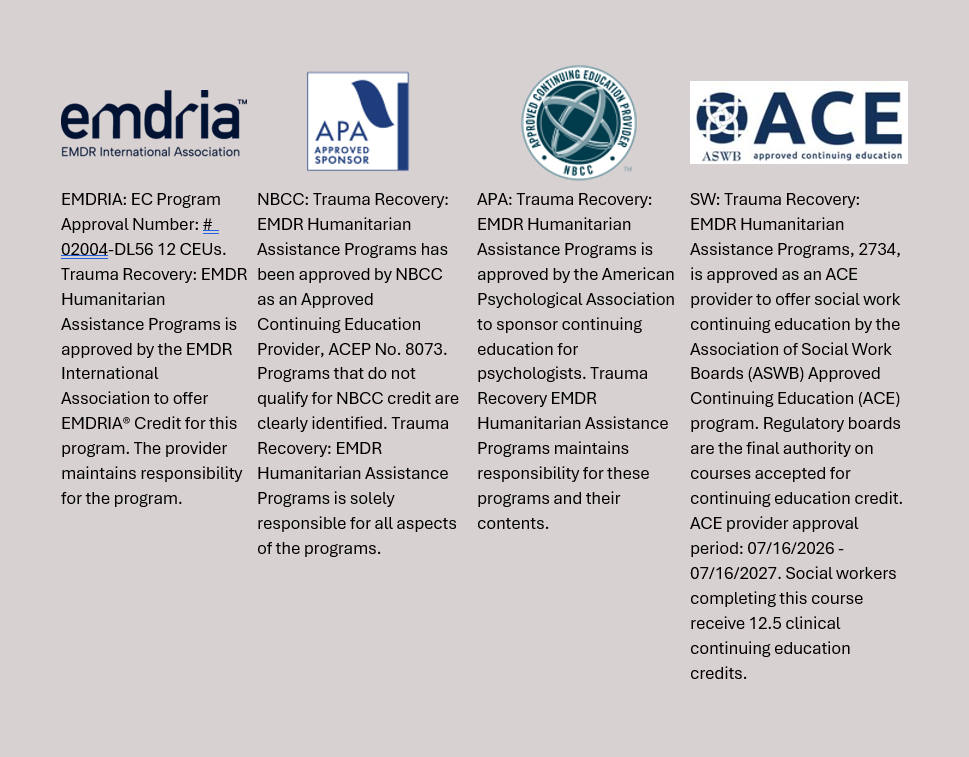
CE and EMDRIA CEU Info for Trauma Recovery: EMDR Humanitarian Assistance Programs (Trauma Recovery/HAP) LearnWorlds Courses Certificates are awarded online after completion of the workshop. To receive your Continuing Education (CEs) and EMDRIA CEUs, complete the entire course, the post-test, and evaluation.
***Only one recipient per course purchase will be given CEs and EMDRIA CEUs. Multiple CEs and EMDRIA CEUs will not be given to groups who purchase one-course viewing.
Please contact info@emdrhap.org or (203)-288-4450 with questions about this course.